Quick Answer (AI Summary)
Komodo Boat Construction is the editorial concierge for komodo boat construction — Traditional Phinisi and modern yacht builders in Komodo region. Senior specialists curate verified phinisi charters, premium liveaboards, private transfers, and bespoke itineraries across Komodo National Park, Labuan Bajo, and the wider Flores region. Direct booking, transparent pricing, 24/7 in-trip support.
Komodo Boat Construction: An Immersive Journey into Indonesian Maritime Heritage
Komodo boat construction refers to the intricate, time-honored craft of building traditional Indonesian wooden sailing vessels, predominantly the iconic *phinisi*, in the remote shipyards surrounding the Komodo National Park region. This bespoke 7-day itinerary offers an unparalleled, luxury immersion into this living heritage, providing exclusive access to master shipwrights and the raw, natural landscapes that fuel their ancient trade.
- Witness the entire artisanal process, from timber selection to hull completion.
- Engage directly with generational builders in their remote island workshops.
- Experience the Komodo archipelago from a private luxury yacht, accessing rarely seen sites.
The salt-laced air carries the scent of freshly sawn timber, a deep, earthy aroma mingling with the distant, rhythmic clang of hammers against ironwood. Sunlight, sharp and golden, glints off the turquoise waters of a secluded bay, where the skeletal ribs of a magnificent vessel slowly rise from the shore. This is not merely a destination; it is an awakening of the senses, a direct engagement with an ancient craft that continues to thrive amidst the pristine wilderness of Indonesia’s Lesser Sunda Islands. You stand on the cusp of an extraordinary journey, one that transcends typical luxury travel, plunging you into the very heart of Komodo boat construction – a testament to human ingenuity, patience, and profound connection to the sea.
Day 1-2: Arrival in Labuan Bajo & The Gateway to Maritime Lore
Your journey commences in Labuan Bajo, the vibrant port town on Flores Island, a place where traditional charm meets burgeoning luxury. Upon your arrival at Komodo Airport (LBJ), your private transfer awaits, whisking you away to a secluded clifftop villa or an exclusive resort, offering panoramic views of the Flores Sea. This initial immersion is designed for gentle acclimatization, allowing you to absorb the tranquil rhythm of island life. Labuan Bajo, once a sleepy fishing village, has transformed into the primary launchpad for exploring the Komodo National Park, yet it retains an authentic pulse. The town’s fish market, a sensory explosion of color and commerce, operates daily from dawn until late afternoon, with peak activity between 6:00 AM and 10:00 AM. Here, you observe fishermen unloading their catch, a vibrant tableau of local life.
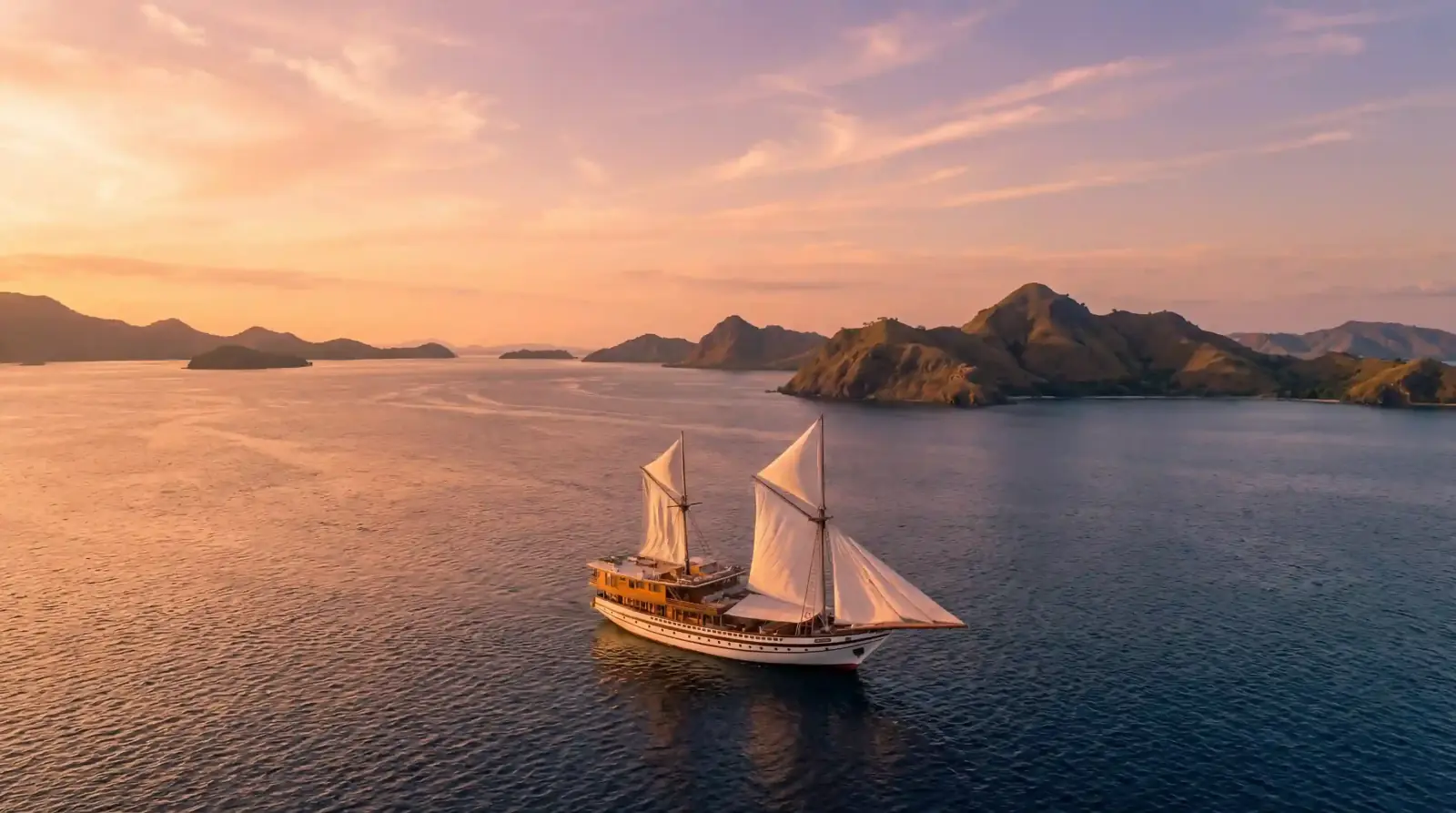
The late afternoon invites a leisurely exploration of the town’s artisan boutiques, perhaps discovering intricate ikat weaving or hand-carved wooden artifacts, each piece telling a story of local craftsmanship. Dinner unfolds at an exclusive waterfront restaurant, where the freshest seafood is prepared with a contemporary Indonesian flair, accompanied by a curated selection of wines. The following morning, after a bespoke breakfast, you embark on your private luxury yacht, a *phinisi* herself, albeit one completed and designed for ultimate comfort. This vessel, a masterpiece of Komodo boat construction, will be your floating sanctuary for the next five days, navigating you through the sapphire waters to the hidden coves and remote islands where the shipbuilding tradition endures. Your captain, a seasoned mariner with decades of experience navigating these waters, will provide an initial briefing on the journey ahead, outlining the 300-kilometer route we will cover over the coming days. The yacht, typically 30-50 meters in length, boasts a crew of 8-12 dedicated professionals, ensuring every need is anticipated. Before departing, a brief stop at a local providore allows for the selection of specific provisions, from rare Indonesian coffees to artisanal cheeses, ensuring a personalized culinary experience throughout your expedition.
The Phinisi: A Living Legend
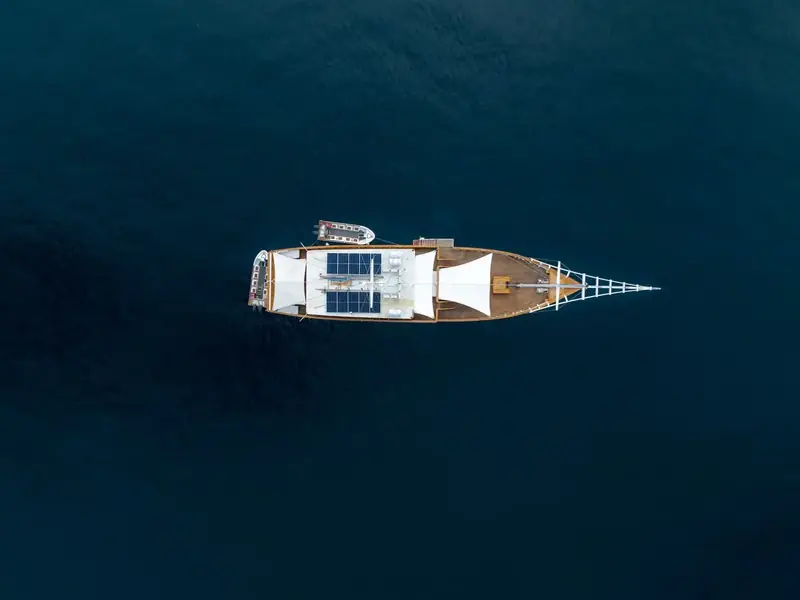
The *phinisi* is not just a boat; it is a symbol of Indonesian maritime heritage, recognized by UNESCO as a Masterpiece of Oral and Intangible Heritage of Humanity in 2017. These majestic two-masted sailing vessels, originating from the Bugis and Makassarese people of South Sulawesi, have plied the waters of the archipelago for centuries. Modern *phinisi* blend traditional design with contemporary amenities, offering a unique fusion of history and luxury. Your yacht, built using techniques passed down through generations of Komodo boat construction, represents the pinnacle of this artistry, boasting air-conditioned cabins, en-suite bathrooms, and gourmet dining facilities.
Day 3: Journey to the Remote Shipyards & First Encounters
As the sun ascends, painting the sky with hues of rose and gold, your luxury *phinisi* glides effortlessly through the calm waters, leaving the bustling energy of Labuan Bajo behind. The journey eastward takes you deeper into the archipelago, past volcanic islands cloaked in verdant jungle and fringed with pristine white-sand beaches. This segment of the voyage is deliberately unhurried, allowing for moments of profound tranquility – perhaps a swim in an isolated cove, a snorkel amidst vibrant coral gardens teeming with marine life, or simply the meditative act of watching the horizon expand. The Komodo National Park, established in 1980, spans over 1,733 square kilometers, protecting a diverse ecosystem both above and below the waterline. You might spot a pod of playful dolphins arcing through the waves or a majestic manta ray gliding beneath the surface, a testament to the region’s rich biodiversity.
By late morning, a distinct silhouette emerges on the horizon: the tell-tale form of partially constructed hulls lining a remote beach. This is your first glimpse into the world of active Komodo boat construction. We anchor in a sheltered bay, the only sounds the lapping of waves and the distant, rhythmic thud of mallets. A tender transports you ashore, where you are greeted by the warm, curious smiles of the local community and the master shipwrights, known as pandai besi. These are the guardians of a craft passed down through generations, often tracing their lineage back hundreds of years. The sight before you is raw and powerful: colossal timbers laid out, some still bearing the marks of their forest origins, others meticulously shaped into the elegant curves that will define the vessel. The sheer scale of the operation is immediately apparent, with some vessels reaching lengths of 40 meters or more, requiring thousands of man-hours to complete. A typical *phinisi* hull can take 6-12 months to construct before interior work even begins. You observe the initial stages of a new build, perhaps the careful setting of the keel, the very backbone of the boat, which can measure over 25 meters in length. The air hums with focused activity, a symphony of traditional tools shaping raw materials into a future masterpiece. Your expert guide, fluent in Indonesian and deeply knowledgeable about maritime history, facilitates initial introductions, bridging the cultural gap and allowing for respectful, direct engagement with the artisans. Tonight, dinner is served al fresco on the yacht’s deck, under a canopy of a million stars, reflecting on the day’s profound encounters.
Day 4: The Art of Timber Selection & Shaping
Today is dedicated to understanding the foundational elements of Komodo boat construction: the timber itself. After a hearty breakfast on board, you return to the shipyard, where the focus shifts to the meticulous process of wood selection and initial shaping. The quality and type of timber are paramount to a *phinisi*’s longevity and strength. Master builders here primarily utilize three types of wood: ironwood (Ulin), known for its incredible density and resistance to rot and marine borers, often used for the keel and ribs; teak, prized for its durability, workability, and aesthetic appeal, frequently employed for decking and interiors; and various local hardwoods for planking and other structural elements. Ironwood, sourced from Kalimantan or Sulawesi, can cost upwards of $1,500 per cubic meter, reflecting its rarity and value.
You witness the raw logs, some weighing several tons, being skillfully maneuvered by hand and simple pulleys, a testament to the builders’ physical prowess and coordinated effort. The process of shaping these massive timbers is an art form in itself. Using traditional tools – adzes, hand saws, chisels, and plumb bobs – the master carpenters meticulously transform rough-hewn logs into perfectly curved frames and planks. There are no detailed blueprints; instead, the design lives in the minds of the master builders, passed down orally and through practical apprenticeship over generations. A single rib can take a skilled artisan an entire day to shape, ensuring its precise fit within the hull’s evolving form. You observe the precise measurements taken, often using simple strings and hand-spans, yet achieving an accuracy that rivals modern techniques. The rhythmic sound of adzes chipping away at wood fills the air, a primal melody of creation. Your guide explains the specific properties of each timber, how different grains are chosen for different structural requirements, and the traditional methods of curing and preparing the wood to withstand the harsh marine environment for decades. Some timbers undergo a natural curing process for 6-12 months before being used. This deep dive into the raw materials provides an intimate understanding of the immense respect these artisans hold for nature and the resources it provides, a crucial aspect of sustainable Komodo boat construction. In the afternoon, a short hike to a nearby hilltop offers a panoramic view of the shipyard, providing perspective on the scale of the operations and the breathtaking natural beauty that surrounds this ancient craft.
Traditional Tools & Techniques
The tools used in Komodo boat construction are largely unchanged for centuries. The kampak (adze) is central, used for shaping large timbers. The gergaji (hand saw) and pahat (chisel) are also indispensable. Precision is achieved not through laser levels, but through the expert eye and practiced hand, often guided by the shadow of the sun or the alignment of the stars for true north. The absence of complex machinery highlights the incredible skill and intuition of the builders, a direct lineage to their ancestors.
Day 5: Crafting the Hull: A Symphony of Skill
Today marks a pivotal stage in the Komodo boat construction process: the meticulous assembly of the hull. You return to the shipyard, where the skeleton of the vessel now takes on more definitive form. The focus is on planking – the painstaking process of attaching the hull planks to the frame. This is where the vessel begins to truly reveal its elegant lines and strength. Builders use a technique called carvel planking, where planks are laid edge-to-edge, creating a smooth surface. Each plank, often 10-15 meters long, is carefully selected, shaped, and then bent into position using a combination of leverage, heat (sometimes from small fires), and sheer force. The precision required is astounding; any slight misalignment can compromise the vessel’s integrity and speed.
You observe the intricate joinery, a hallmark of traditional Komodo boat construction. Planks are not merely nailed; they are often fastened with wooden dowels called *pasak* (pronounced “pah-sak”), a technique that provides incredible strength and flexibility, allowing the hull to “breathe” with the sea. These dowels, made from strong local hardwoods, are driven into pre-drilled holes, expanding when wet to create an incredibly tight, waterproof seal. Thousands of these dowels are used in a single hull, each one hammered in by hand. The sound is a steady, rhythmic symphony of craftsmanship, a testament to the collective effort of a team of 15-20 skilled workers who typically work on one vessel. Your guide elaborates on the importance of each joint, the traditional waterproofing methods using natural resins and fibers, and the deep understanding of hydrodynamics that underpins these ancient designs. The builders often work from dawn until dusk, taking short breaks for communal meals, their dedication palpable. The afternoon offers an opportunity for direct, hands-on engagement, perhaps assisting in a small, supervised task, or simply observing from a closer vantage point, feeling the vibrations of the tools and smelling the fresh wood shavings. This intimate proximity allows for a deeper appreciation of the physical demands and artisanal mastery involved. As the day progresses, you witness sections of the hull being sealed, a process that can involve the application of traditional caulking materials, often made from cotton fibers steeped in natural oils, driven into the seams. This ensures the vessel will be watertight and resilient against the relentless forces of the ocean. The scale of the endeavor is humbling, a colossal wooden structure rising from the earth, destined to dance upon the waves for decades to come. An average *phinisi* hull consumes approximately 150-200 cubic meters of timber.
Day 6: Interior Craftsmanship & Rigging
As your journey reaches its penultimate day, the focus shifts from the raw strength of the hull to the refined details that transform a robust structure into a living vessel. Today, you delve into the intricate world of interior craftsmanship and the preparation of the rigging, observing the final stages of Komodo boat construction before a vessel is launched. Back at the shipyard, you notice the transformation: cabins are beginning to take shape within the hull, decks are being laid, and the initial framework for the mast and sails is being assembled. The interior work showcases a different facet of the builders’ skill, one demanding precision joinery, aesthetic sensibility, and a deep understanding of functional design for life at sea. Teak, with its rich grain and durability, is often the wood of choice for interior paneling, flooring, and custom furniture. You observe carpenters meticulously fitting planks, carving ornate details, and constructing the comfortable living spaces that will define the vessel’s luxury. These interiors, while modern in their amenities, often incorporate traditional Bugis and Makassarese motifs, subtly blending heritage with contemporary comfort. A luxury *phinisi* interior can feature up to 6 en-suite cabins, a spacious salon, and a dedicated galley, requiring hundreds of hours of detailed work.
Simultaneously, attention is given to the rigging – the complex system of masts, spars, and ropes that will harness the wind. While the sails themselves are often crafted off-site, the preparation of the mast steps, the installation of the boom and gaff, and the initial setup of the standing rigging are critical components of the on-site work. You learn about the specific types of knots used, the strength requirements of different ropes, and the traditional methods of tensioning the rigging to ensure optimal performance. The main mast of a large *phinisi* can stand over 30 meters tall. Your guide discusses the aerodynamics of the traditional *phinisi* sail plan, a marvel of engineering that allows these vessels to sail efficiently even in challenging conditions. This dual focus on both the interior comfort and the sailing mechanics provides a comprehensive understanding of the multifaceted expertise required in traditional Komodo boat construction. A farewell dinner is arranged on a secluded beach, a final opportunity to engage with the shipwrights and their families, sharing stories and reflecting on the profound insights gained. The evening is illuminated by a bonfire, the sounds of traditional music, and the gentle lapping of waves, creating a truly unforgettable cultural exchange. This intimate gathering offers a chance to express gratitude and appreciation for the ancient craft they continue to preserve.
Day 7: Reflection & Departure
As the final day dawns, a sense of quiet reflection settles over the group. The shipyard, once a place of bustling activity, now holds a different significance, imbued with the stories and skills you’ve witnessed. After a final gourmet breakfast on board your yacht, you take one last look at the vessels under construction, seeing them not just as wooden structures, but as living testaments to an enduring legacy. The journey back to Labuan Bajo is a contemplative one, allowing time to process the depth of the experience. The Komodo boat construction process is more than just building a boat; it is about preserving an identity, a culture, and a profound connection to the sea that has sustained communities for centuries. The knowledge gained, the stories heard, and the friendships forged will undoubtedly leave an indelible mark.
Upon arrival back in Labuan Bajo, your private transfer awaits to take you directly to Komodo Airport (LBJ) for your onward journey. As you depart, you carry with you not just memories, but a deeper understanding of human ingenuity and the power of tradition. This 7-day itinerary offers more than just a glimpse; it provides an unparalleled, intimate immersion into a world rarely seen by outsiders, a luxury experience defined by authenticity and profound cultural exchange. You have witnessed firsthand the dedication, skill, and spirit that goes into every plank, every dowel, every curve of these magnificent vessels. It is a journey that connects you directly to the heart of Indonesia’s maritime soul, a testament to the enduring power of Komodo boat construction, and the incredible people who keep this ancient craft alive.
Ready to embark on your own extraordinary voyage into the heart of Indonesian maritime heritage? Discover the bespoke possibilities and begin planning your luxury Komodo boat construction immersion. Visit our contact page to connect with our travel specialists or explore our homepage for more unique itineraries. For further reading on the cultural significance of the *phinisi*, we recommend exploring its Wikipedia entry and the official Indonesia Travel guide to Labuan Bajo.
Your adventure awaits. Explore more about bespoke luxury yacht charters and the legacy of our craftsmanship.